
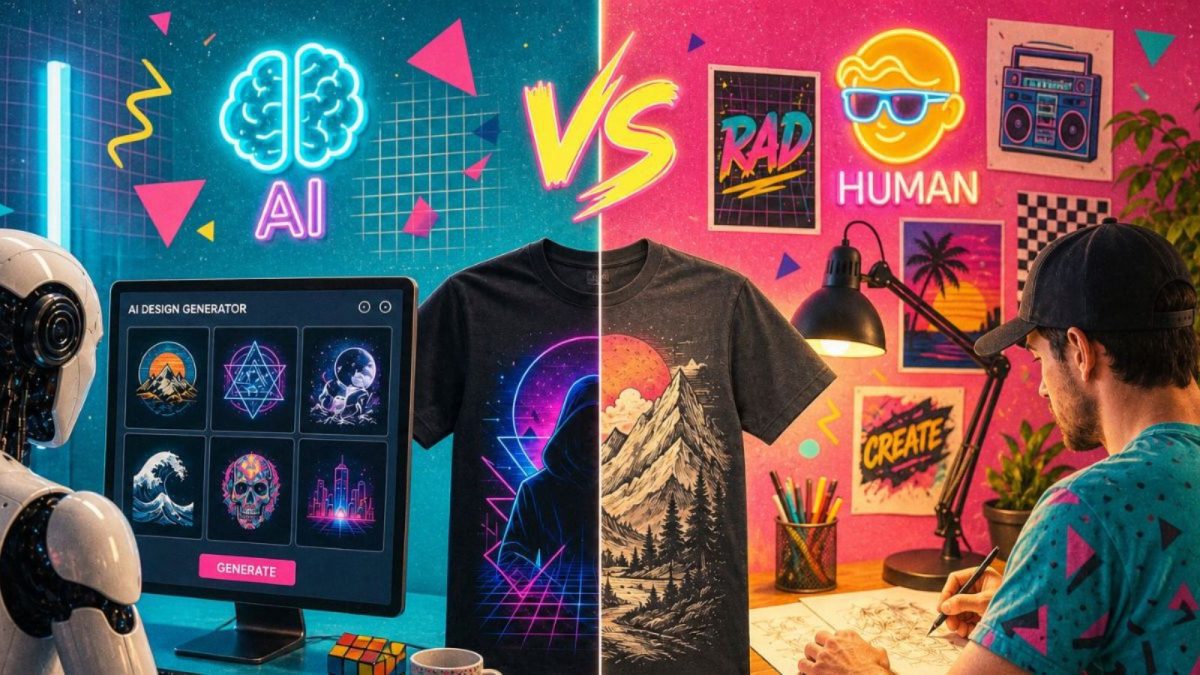
Creating a custom t-shirt once meant hiring a designer or learning complicated software. Today, choosing AI vs human designers plays a big role in how custom apparel is created.
That shift has changed how businesses, clothing brands, and online shops approach design. While AI makes the process faster, many still question whether it can match human creativity.
The answer depends on what you’re creating. Some shirts only need quick concepts, while others require originality, personality, and a clear audience connection.
Why AI T-Shirt Design Has Become More Popular
AI tools are popular because they simplify the early design process.
Instead of starting from scratch, you enter a prompt and get multiple concepts instantly. For example:
- Vintage racing graphics
- 90s arcade-style artwork
- Distressed beach sunset designs
- Old-school band tee aesthetics
Within seconds, ideas appear that would normally take much longer to sketch.
For small businesses and casual creators, this speeds up brainstorming. It also makes it easier to test different styles, colors, and layouts without rebuilding designs each time.
Where AI Works Best in T-Shirt Design
AI is most effective as a support tool, not a full replacement for design work.
It is useful for:
- Quick mockups
- Initial concept ideas
- Color palette exploration
- Typography inspiration
- Vintage-style textures
- Pattern generationThis makes it helpful for event shirts, small business merch, or early-stage creative exploration where direction is still flexible.
The Biggest Limitations of AI-Generated Designs
AI-generated designs can look polished at first glance, but often lack depth on closer inspection.
Because AI relies on patterns instead of intent, results may feel generic or disconnected from a clear idea.
Common issues include:
- Distorted or unreadable text
- Crowded or unbalanced layouts
- Inconsistent proportions
- Random visual elements
- Similarity to existing designs
Some artwork also does not translate well to fabric. Fine details, low contrast, or overly complex compositions can reduce print quality.
Without refinement, the final shirt may not match the original preview.
Why Human Designers Still Matter
Human designers bring creative direction that AI cannot consistently replicate.
They understand how shirts are worn, what styles connect with specific audiences, and how to balance visuals for both digital and print use.
This is especially important for:
- Clothing brands
- Streetwear collections
- Event merchandise
- Business apparel
- Retro-inspired fashion
- Limited releases
Designers build around intent instead of prompts. Retro apparel, for example, relies on controlled textures, typography choices, and spacing to achieve an authentic feel rather than an artificial one.
They also know when a concept isn’t working and can change direction entirely instead of producing more variations of the same idea.
Combining AI Speed With Human Design Skills
Many creators now use both approaches together.
AI is often used for early-stage work, such as:
- Exploring ideas
- Testing directions
- Generating slogans
- Creating rough mockups
- Building mood boardsOnce a direction is selected, a designer refines typography, simplifies layouts, adjusts colors, and prepares print-ready files.
This workflow keeps the speed of AI while maintaining design quality and intention.
The Final Shirt Matters More Than the Tool
A strong design is not just about how it looks on screen. It has to work as a real product.
Good apparel design considers:
- Fabric color contrast
- Print placement
- Readability
- Comfort
- Durability
- Wearability
Overly complex AI-generated designs often need simplification before printing. Cleaner layouts usually perform better and last longer in everyday wear.
Human designers naturally account for these limits during the creative process.
Design Factor Comparison
| Design Factor | AI Designers | Human Designers |
|---|---|---|
| Speed | Fast idea generation | Slower, more deliberate |
| Originality | Often repetitive | More unique and intentional |
| Print Quality | May need adjustment | Print-ready focus |
| Brand Identity | Limited depth | Stronger direction |
| Flexibility | Great for experimentation | Better at refinement |
| Best Use | Early concepts | Final apparel design |
Frequently Asked Questions
Is AI good for creating custom t-shirt designs?
AI can be useful for generating quick ideas, testing layouts, and exploring different styles. Many people use it during the early concept stage before refining the artwork for printing.
Can AI-generated t-shirt designs be copyrighted?
Copyright rules for AI-generated artwork can vary depending on how much human involvement was part of the design process. Many businesses still modify or refine AI concepts to create more original final artwork.
Do professional t-shirt printers accept AI-generated designs?
Most print shops will accept AI-generated files if they meet proper resolution and formatting requirements. However, some artwork may need cleanup before printing to avoid blurry graphics or distorted details.
Are AI t-shirt designs cheaper than hiring a designer?
AI tools are usually less expensive upfront because they automate much of the creative process. Hiring a designer often costs more, but it can result in stronger branding, better print quality, and more original apparel.
Can human designers use AI during the design process?
Yes, many professional designers now use AI to speed up brainstorming and explore creative directions faster. The final artwork is still typically refined manually to improve quality and wearability.
Retro Shirtz Custom Bulk T-Shirts Printing near Regency inside Westroads Mall in Omaha
At Retro Shirtz we understand the importance of logo design. So we provide free graphic design, including free logo design with all standard custom shirt orders.
Our free graphic design services include:
- suggesting and implementing fonts
- changing the colors and layout of the fonts, and our team’s excellent skills at creating custom image assets.